

Dogs can be affected by flea infestations. Fleas can infest dogs, causing discomfort and, in some cases, contributing to flea-related health concerns. But thanks to veterinary science, you now have access to a wide range of flea treatments that can help keep these parasites at bay and ensure the well-being of your canine baby.
However, the wide range of flea-control methods available on the market can often overwhelm and confuse you. That’s why we’re here to help! In this blog, we will compare two widely used flea treatments for dogs: flea collars for dogs and chewables. We will also highlight their pros and cons to help you make a conscious choice for your pooch.
Read on to find out more!
An Overview
Let’s take a quick overview of the key features of flea and tick collars and oral chewables.
Flea & Tick Collars
Flea and tick collars are used to provide dogs with long-lasting protection against fleas and ticks. They are widely preferred by pet parents for their long-lasting protection, odorless and non-greasy design, water-resistant property, and adjustable fit. Some flea and tick collars are designed to kill and/or repel parasites and kill them through contact, thus effectively preventing new infestations. Some of the most effective flea and tick collars include Seresto Flea and Tick Collar for Dogs, Scalibor Flea & Tick Collars for Dogs, and Bob Martin Clear Tick & Flea Collar for Dogs.
Oral Chewables
Oral Chewables designed for flea control are often formulated to be palatable for ease of administration. Depending on their ingredients, flea treatments may also protect dogs against other parasites like ticks, mites, lice, intestinal worms, and heartworms. Therefore, it is important that you carefully read the product label or seek your veterinarian’s guidance to determine which product is appropriate for your pet. Some of the most effective oral chewables that work well against fleas are Bravecto for Dogs, NexGard Chewables, and Simparica Chewables.
Flea Collars vs. Chewables – Key Differences
Here are the key differences between flea collars and oral chewables.
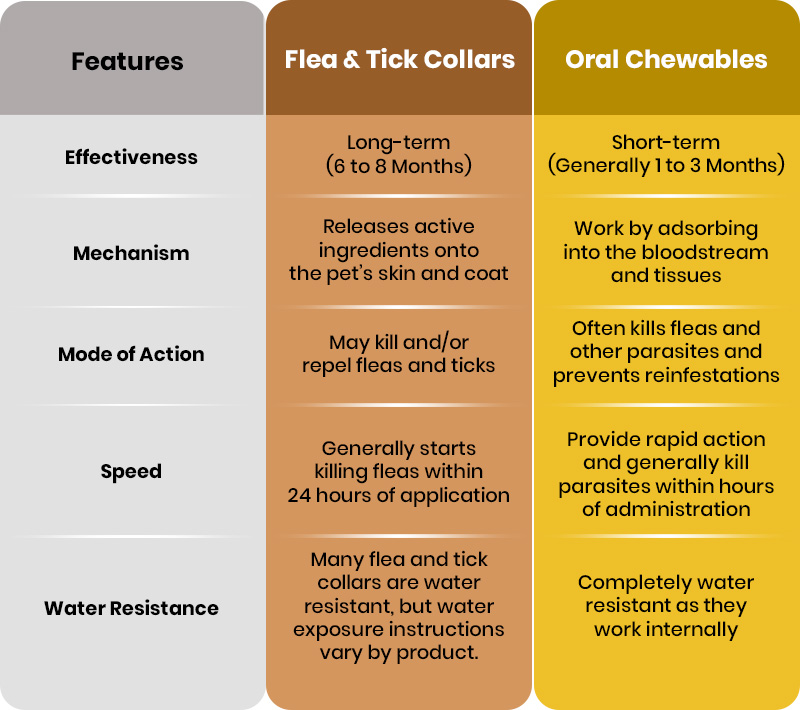
Collars & Oral Chewables – Pros & Cons
The following are the pros and cons of flea collars and oral chewables.
Flea Collars
Pros
- May provide protection for several months against fleas and other parasites.
- Convenient option for dogs that are difficult to medicate orally.
- Steadily releases active ingredients, instead of offering a concentrated application at a time.
Cons
- Collars may cause discomfort for certain dogs and lead to skin irritation.
- If not fitted correctly around the dog’s neck, collars may not work as intended.
Oral Chewables
Pros
- Oral chews designed to treat fleas generally offer quick action and start killing parasites within minutes or hours of administration.
- As chewables work internally, they can be used to treat dogs that require frequent swimming or are active swimmers.
Cons
- Administering chewables may be difficult for dogs that are picky eaters.
- Many oral flea treatments do not repel fleas, so fleas may need to feed on the dog before being exposed to the active ingredient.
Which One to Go for? Flea Collars or Chewables?
While choosing a suitable flea treatment for your four-legged baby, you can consider an option that fits your dog’s lifestyle and your ability to administer the product consistently. While collars are often considered more cost-effective, the overall cost can vary depending on the product, dosing interval, and duration of protection. However, some oral products may begin killing fleas more quickly than certain collars.
You can get in touch with your veterinarian, who can help you determine an option that best suits your dog’s unique requirements.
Bottom Line
At CanadaPetCare, we carry a plethora of flea collars as well as oral chews at the best prices. Explore our online store to purchase your preferred flea preventives for dogs from the comfort of your home.